



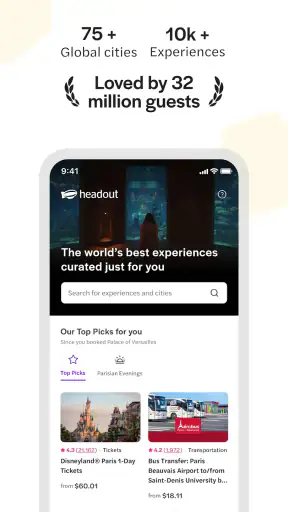
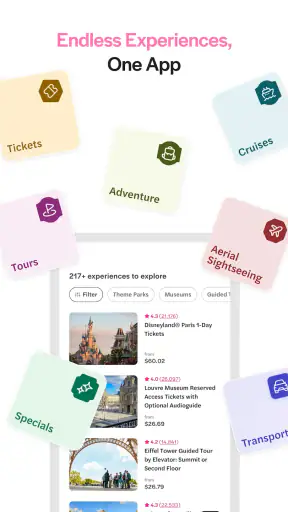
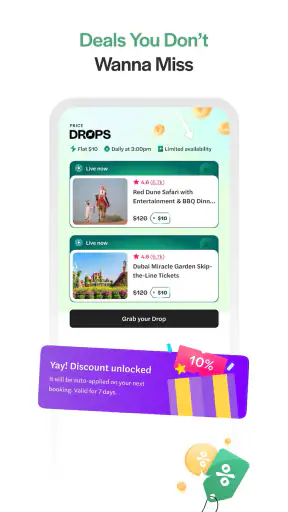

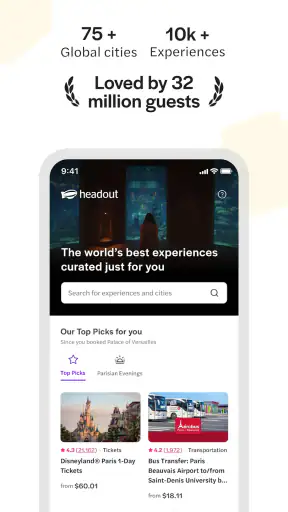
I use travel apps most when I am already moving: standing outside a station, deciding what to do after lunch, or trying to turn an empty evening into something worth remembering. Headout is built for that kind of decision. It is a free Travel & Local app from Headout that brings tours, events, activities, and last-minute ticket options into one browsing experience. My overall impression is that it is most useful when I want to compare available experiences quickly rather than spend an hour opening separate attraction, venue, and tour websites.
The app has a strong public track record, with a 4.8 average from roughly 19 thousand ratings and more than a million installs. That does not make every booking perfect, but it does make Headout feel like an established travel companion rather than an experimental side project. It is rated for Everyone, and the current version is 10.0.2, so the app is presented as a mature option for a broad audience.
How Headout feels when I need something quickly
The first thing I notice with a travel-booking app is not the number of destinations. It is how quickly I can move from “we should do something” to a realistic choice. Headout generally makes sense for that moment because it focuses on experiences instead of trying to become a complete trip planner. I can browse possibilities such as tours, attractions, events, and activities without first building an entire itinerary.
That narrow purpose helps the experience feel more direct than a general search engine. A normal web search often mixes official venue pages, blog recommendations, old articles, map results, and reseller pages. Headout gives me a more focused place to begin. I still need to read the booking details carefully, but the initial discovery stage is less scattered.
The real speed advantage is decision speed, not a promise of instant loading. I would not judge it by a stopwatch because connection quality, location, and the amount of content being displayed all affect the result. In ordinary use, its value is that I can move through travel ideas with less mental switching. That matters when I am on a phone and making plans with another person beside me.
For a spontaneous afternoon, I would use it differently from a carefully planned holiday. I might search for an activity near where I am staying, compare a few formats, then inspect the practical information before choosing. For a major attraction with a fixed date, I would use Headout as one research and booking route, but I would also check the attraction’s own information when entry rules, timed admission, or special conditions are especially important.
What makes the browsing workflow useful
Headout works best when I begin with a clear intention. “Find something indoors tonight” is more useful than opening the app with no idea whether I want culture, sightseeing, entertainment, or a guided experience. Once I know the type of outing, I can spend more time comparing the character of each option instead of endlessly scrolling.
One practical habit is to separate discovery from commitment. I first collect a small group of possibilities, then inspect the details of each one in turn. This prevents the most visually appealing listing from winning automatically. I look for the meeting arrangement, timing, duration, what the ticket actually covers, and whether the activity suits the people travelling with me.
This is also where the app’s last-minute focus can be helpful. If a plan changes during a trip, I do not necessarily need a perfect long-term itinerary. I need a workable option that fits the remaining time. Headout is more relevant in that situation than a traditional guidebook, although availability and suitability still need to be checked before I pay.
Using it during a realistic travel day
Imagine I have arrived in a city with a free evening. The weather is poor, one person in the group is tired, and we do not want a complicated journey across town. I would open Headout to look for an experience that matches those constraints, then compare the time commitment rather than simply choosing the most famous attraction. A shorter indoor activity may be a better choice than a distant full-day tour, even if the latter looks more impressive.
After selecting a possibility, I would save or capture the important booking information in a way I can retrieve without relying on memory. I would also check the route before leaving, because a ticket can be valid while the practical journey remains inconvenient. This is an important trade-off: Headout can simplify finding an experience, but it cannot remove local transport delays, queues, weather, or the need to arrive prepared.
For a family, I would pay particular attention to age suitability and the pace of the activity. The app itself is rated for Everyone, but that is an app content rating, not a guarantee that every listed experience is ideal for every child. A parent should still inspect the individual activity information and decide whether the schedule and setting are appropriate.
Where heavier use can expose friction
Light browsing is the easiest way to use a travel app. The more demanding situation is a busy travel day when I am repeatedly changing dates, comparing several activities, returning to previous listings, and checking details while moving between networks. That is when a clean browsing flow matters most, because small delays become irritating when I am already under time pressure.
I would avoid treating the app as my only source of critical information during a complicated trip. If a booking affects a flight connection, a group of people, or a non-refundable schedule, I would keep the confirmation details accessible and verify the plan before setting out. This is not a criticism unique to Headout; it is sensible behaviour for any mobile booking service. The app can help me choose, but my travel plan should not depend on one screen being available at exactly the right moment.
Another heavy-use issue is attention. A large selection can be useful, but it can also encourage over-comparison. After a point, opening more listings does not improve the decision. I get better results when I define two or three requirements first, such as location, time, and activity length. That makes Headout feel lighter to use and reduces the chance of booking something attractive but impractical.
For frequent travellers, I would also distinguish between browsing several cities and managing a single confirmed plan. Headout is naturally stronger at discovering and arranging individual experiences than at replacing a dedicated itinerary manager, calendar, transport app, or official venue account. I would use it alongside those tools rather than expecting one app to coordinate every part of a trip.
Reliability and the habits I would keep
Reliability in travel is more than whether an app opens. I want the listing to be understandable, the booking process to be clear, and the final information to remain usable when I am away from home. Headout’s established presence and large user base give me reasonable confidence in using it for ordinary experience planning, but confidence should not become carelessness.
Before confirming anything, I read the conditions that affect the day itself. I check the date and time, the meeting point or venue, the expected duration, and the exact nature of the ticket. If the activity involves a guided tour, I want to know where I need to be and how early I should arrive. If it is an event, I want to understand whether the booking is for entry only or includes something more specific. These checks are more valuable than simply trusting a short title.
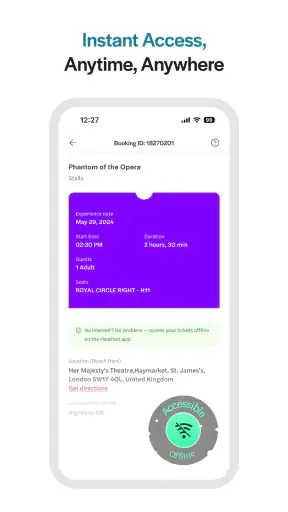
I also recommend keeping the confirmation easy to find. A traveller may lose signal, run low on battery, or need to show the booking while standing in a crowded entrance. I would not wait until the last minute to discover that I need a particular screen or detail. The app is useful as the place where I arrange the experience, but I still take responsibility for making the final proof of booking accessible.
When plans change, I would look at the booking’s own terms before assuming that an adjustment is simple. Travel platforms can make discovery and purchase convenient, while changes may still depend on the individual experience. That is why I consider the conditions part of the product, not fine print to ignore. Headout is a better fit for me when I am willing to read those details instead of treating every ticket as interchangeable.
Device limits, operating system, and resource expectations
Headout supports devices running Android 7.0 or later, which gives it a broad compatibility range. That is useful if I travel with an older Android phone rather than a recent flagship. At the same time, compatibility does not mean every older device will feel equally comfortable. A phone with limited storage, a weak battery, or slow network performance can make any image-rich travel catalogue feel less convenient.
I would expect normal travel-app demands: browsing visual listings, moving between pages, and using a connection to retrieve current information. I would not install it immediately before leaving without checking that my phone has enough free space and battery for the whole day. The application is free, but the phone resources involved in using it still matter, especially when the same device is handling maps, messages, photos, and translation.
On an older phone, I would reduce unnecessary background activity before a busy day and carry a charging option. That advice is not because Headout is known to be unusually demanding; it is because travel apps are most valuable when the phone is already doing several jobs. A smooth booking experience is of little help if the device shuts down before I reach the venue.
Users on iPhone or Android should also think about their preferred travel workflow. If I already rely heavily on a browser, a wallet, and an official attraction app, adding Headout may create more places to check. Its advantage is the focused discovery and booking layer. Its disadvantage is that it does not automatically replace every other travel tool I use.
Who will get the most from it
I would recommend Headout to travellers who enjoy choosing experiences after they arrive, people comparing several activities in one city, and anyone who wants a more focused alternative to broad web searches. It is especially appealing when the question is “what can we do?” rather than “how do I manage every reservation on this trip?”
It can also suit visitors who do not know the local attractions well. Instead of beginning with a blank map, I can use the app to see the kinds of tours, events, and activities available, then narrow the list according to time and interest. That makes it useful for first-time visitors, couples looking for an evening plan, and small groups that need a shared starting point for discussion.
I would be more cautious recommending it to someone who wants a single official source for a particular venue, a detailed multi-day itinerary, or highly specialized local information. In those cases, the attraction’s own app or website may be the better final authority. A general booking marketplace can be convenient, but the official channel may provide the most direct operational information for a venue-specific question.
How it compares with familiar alternatives
The usual alternative is a search engine. That route offers breadth, but it also creates more work: I have to judge which pages are current, distinguish official information from reseller material, and compare options across separate tabs. Headout is more convenient for discovery because it keeps the experience-shopping task in one place. The trade-off is that I should not assume one marketplace view replaces checking important venue details.
Another alternative is booking directly through an attraction or event provider. Direct booking can feel preferable when I already know exactly where I want to go and want the source closest to the venue. Headout becomes more useful when I am still deciding, want to compare different types of experiences, or need a last-minute idea rather than a single known ticket.
Travel guides and social recommendations offer a different strength: context. They can explain neighbourhood character, local habits, and why an experience is worth the time. Headout is more action-oriented. It helps me move from inspiration toward a bookable choice, but I would still use independent reading when the quality of the experience depends heavily on local context or personal taste.
My performance verdict after weighing convenience against control
Headout is not a complete travel operating system, and I would not use it as one. Its strongest role is a practical layer between vague travel inspiration and a specific activity. The app is free, broadly accessible, and mature enough to deserve a place in my travel folder, particularly when I want to browse tours, events, attractions, or last-minute possibilities without starting from scattered search results.
The current 10.0.2 release and the developer’s established presence suggest an app that is being maintained as a serious travel product. I still judge it by the moment that matters: whether I can find a suitable experience, understand what I am booking, and retrieve the necessary details when the day arrives. On those terms, it is most convincing when used deliberately rather than passively.
My advice is simple: use Headout for discovery and comparison, narrow choices according to real travel constraints, read the individual booking information, and keep the confirmation available offline or in an easy-to-reach place. That workflow reduces the common risks of spontaneous booking while preserving the app’s main benefit.
My final recommendation is positive for flexible experience planning, but conditional for high-stakes arrangements. If I am choosing something enjoyable for today or tomorrow, Headout can save time and make the options feel manageable. If a booking must fit a tight connection, a complex group schedule, or a venue-specific requirement, I would pair it with official information and a backup plan. Used with that level of judgement, it is a useful travel companion rather than a tool I expect to solve every part of the journey.


